
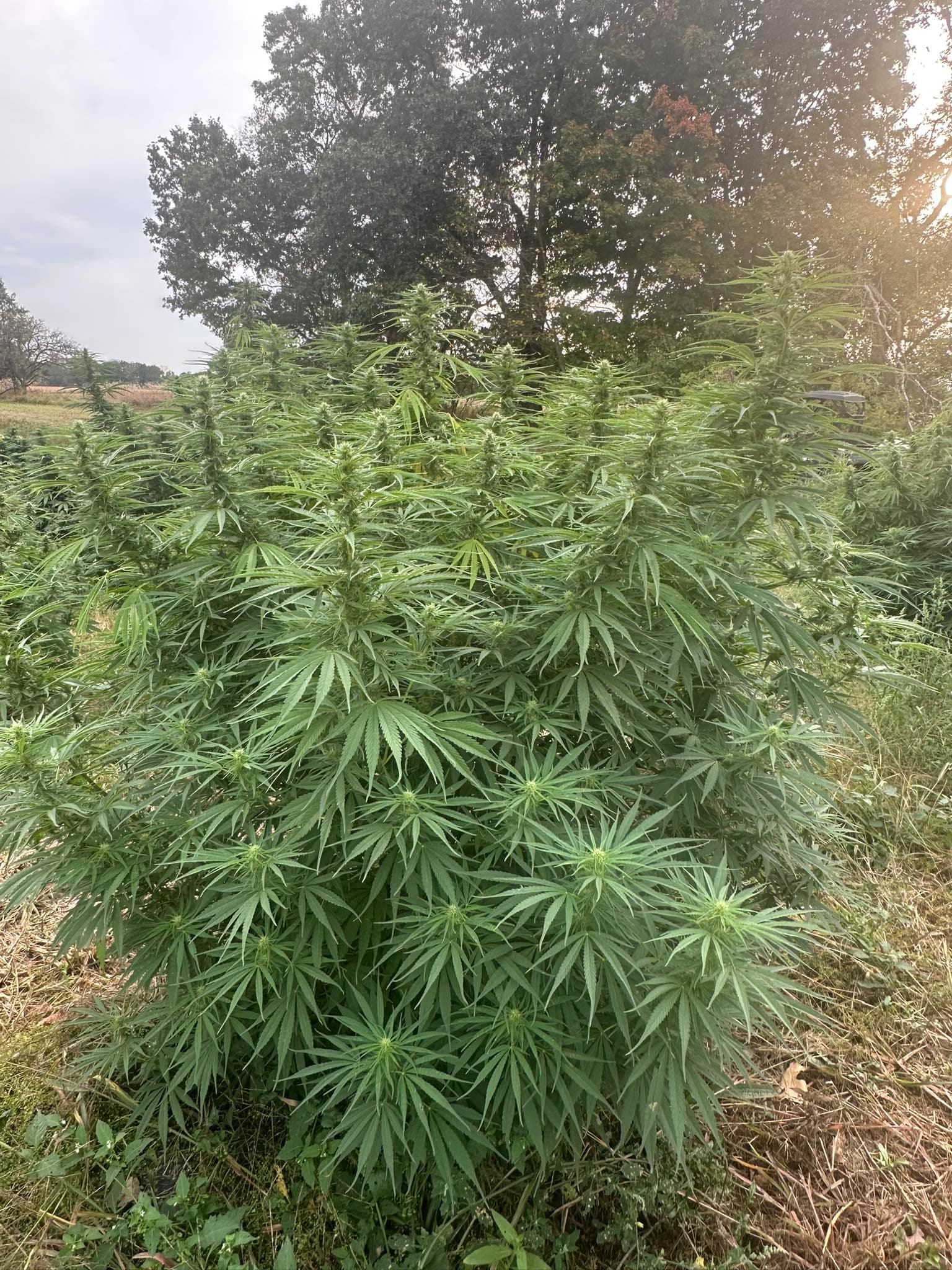
CBG vs THC: Understanding the Difference
CBG and THC are both cannabinoids found in the cannabis plant. That is where the similarity ends. One gets you high. The other does not. One is federally illegal. The other is legal in all 50 states. Here is the full comparison — receptor science, legal status, drug testing implications, and who should choose what.
Last updated: April 2026
The short answer
CBG does not get you high. THC does. That is the single most important difference. Everything else — legal status, drug test implications, receptor mechanisms, use cases — flows from that fundamental distinction.
CBG (cannabigerol) is a non-psychoactive cannabinoid. It is the biosynthetic precursor to THC, CBD, and CBC — meaning the cannabis plant produces CBG first and then converts it into other cannabinoids as it matures. CBG flower is harvested early, before that conversion occurs, preserving high CBG content and keeping THC levels negligible.
THC (delta-9-tetrahydrocannabinol) is the primary psychoactive compound in cannabis. It is what produces the "high" — euphoria, altered perception, impaired short-term memory, appetite stimulation, and in some people, anxiety or paranoia.
Full comparison table
| Property | CBG | THC |
|---|---|---|
| Psychoactive? | No | Yes |
| Federal legal status | Legal (2018 Farm Bill, <0.3% THC) | Schedule I (federally illegal) |
| P.L. 119-37 compliant? | Yes (ultra-low total THC) | No (exceeds 0.4mg cap) |
| Primary receptor | CB2, weak CB1 partial agonist | CB1 (strong agonist) |
| Intoxication | None | Yes — euphoria, altered perception |
| Reported experience | Subtle calm, focused ease | Euphoria, relaxation, impairment |
| Drug test risk | Very low (CBG not tested; trace THC possible) | High (THC-COOH is the target metabolite) |
| Impaired driving? | No | Yes (DUI risk) |
| Source | Hemp (Cannabis sativa, <0.3% THC) | Cannabis (marijuana strains) |
How they work in the brain: CB1 vs CB2 receptors
The reason THC gets you high and CBG does not comes down to a single receptor: CB1.
The endocannabinoid system (ECS) has two primary receptor types. CB1 receptors are concentrated in the central nervous system — the brain and spinal cord. When a compound strongly activates CB1 receptors, the result is psychoactive: altered perception, euphoria, impaired memory, and the experience people call being "high."
CB2 receptors are concentrated in the peripheral nervous system and immune cells. Activation of CB2 receptors is not psychoactive — it is associated with immune modulation and inflammatory response.
THC is a strong agonist at CB1 receptors. It binds tightly and activates them fully. This is the mechanism that produces intoxication. It is also why THC can cause anxiety and paranoia in some users — CB1 activation in the amygdala can amplify fear responses.
CBG has a different receptor profile. Research published in Psychopharmacology and the British Journal of Pharmacology describes CBG as a weak partial agonist at CB1 — meaning it binds to the receptor but does not activate it strongly enough to produce psychoactive effects. Some studies also suggest CBG may act as a competitive antagonist at CB1 in the presence of THC, potentially blunting the high rather than contributing to it. CBG shows stronger affinity for CB2 receptors and also interacts with alpha-2 adrenergic receptors and 5-HT1A serotonin receptors, which may account for the reported calming and focus-enhancing effects.
The practical translation: THC changes how you think and perceive. CBG does not. You can smoke CBG flower and remain fully present, fully functional, fully you — just slightly calmer.
Legal status: a different universe
The legal distinction between CBG and THC is not a gray area — it is a bright line.
THC (delta-9- tetrahydrocannabinol) is a Schedule I controlled substance under federal law. Despite state-level legalization in many states for medical or recreational use, it remains federally illegal. Possession across state lines is a federal offense. Employment-related drug testing targets THC specifically. Federal employees, military personnel, and workers in regulated industries cannot use THC regardless of state law.
CBG from hemp is federally legal under the 2018 Farm Bill (Agriculture Improvement Act). Hemp is defined as Cannabis sativa with no more than 0.3% delta-9 THC by dry weight. CBG flower is naturally ultra-low in THC and sits comfortably within this definition. It can be legally purchased, possessed, and shipped in the vast majority of states.
Looking forward: P.L. 119-37 takes effect in November 2026 and establishes a 0.4mg total THC cap per product. This new threshold will render many full-spectrum CBD products non-compliant. CBG flower, with its naturally negligible total THC content, clears this bar easily. For more detail, see our state-by-state legal guide.
Drug testing: what you need to know
Standard workplace drug tests — the SAMHSA 5-panel and its variations — screen for THC-COOH, the metabolite your body produces when it processes THC. They do not screen for CBG.
CBG itself will not trigger a positive drug test. However, CBG flower is hemp, and hemp legally contains up to 0.3% delta-9 THC by dry weight. This is a trace amount, but it is not zero. If you consume large quantities of hemp flower frequently, trace THC metabolites can accumulate in your system.
The standard immunoassay screening cutoff is 50 ng/mL for THC-COOH. The GC-MS confirmation cutoff is 15 ng/mL. Most casual CBG flower users will not approach these thresholds. But if your career depends on passing a drug test, you should understand the risk is not zero. We cover this in depth in our CBG and drug testing guide.
With THC cannabis, the drug test risk is straightforward: you will test positive. THC metabolites are detectable for 3-30+ days after use depending on frequency and body composition.
Who should choose CBG
CBG flower is not a replacement for THC cannabis. They are different products for different needs. Here is who benefits most from CBG:
- Tolerance break smokers. You want the ritual and the calm without resetting your tolerance or consuming THC. CBG does not activate CB1 receptors enough to affect tolerance.
- Drug-tested workers. You need something that is not THC but still gives you a smoking ritual and mild relaxation. CBG is the lowest-risk smokable option (though trace THC risk exists — see our drug test guide).
- Sober-curious consumers. You are cutting back on alcohol and want a physical ritual that provides a subtle effect without impairment. See our guide to sober curious alternatives.
- THC-sensitive individuals. Some people experience anxiety, paranoia, or racing thoughts with THC. CBG does not produce these effects because it does not strongly activate CB1 receptors.
- People in illegal states. If you live in a state where THC cannabis is still illegal, CBG flower gives you a legal smokable option that you can buy online and have shipped to your door.
Who should choose THC
THC serves needs that CBG genuinely cannot. We are not anti-THC — we are pro-honesty.
- Medical patients. People using cannabis under medical supervision for chronic pain, nausea (chemotherapy), PTSD, or other conditions may specifically need THC's CB1 activation for therapeutic effect. CBG is not a substitute for prescribed medical cannabis.
- Recreational users seeking intoxication. If you want to get high, CBG will not do that. It is not a weaker version of THC — it is a fundamentally different experience.
- People who benefit from strong appetite stimulation. THC activates CB1 receptors in the hypothalamus, which directly stimulates appetite. CBG does not produce this effect at the same intensity.
Can you use CBG and THC together?
Yes. Some users combine CBG and THC cannabis — either mixed in a joint or used at different times of day. Anecdotal reports suggest that CBG may modulate the THC experience, potentially reducing anxiety while preserving relaxation. This is consistent with CBG's potential role as a partial CB1 antagonist in the presence of a strong agonist like THC.
This combination approach is sometimes called "the entourage effect" — though that term is imprecise and covers a broad range of cannabinoid interactions. The clinical evidence for specific CBG-THC interactions in humans is still early-stage. What we can say is that CBG does not amplify the high — if anything, it appears to soften it.
For a broader look at cannabinoid combinations, see our CBG vs CBD comparison.
What CBG flower actually feels like vs THC
The most honest way to describe it: THC is a loud experience. CBG is a quiet one.
With THC, you know something happened. Your perception shifts. Music sounds different. Food tastes different. Time feels different. For some people this is therapeutic. For others it is recreational. For some it is uncomfortable.
With CBG, the shift is subtle enough that you might question whether anything happened at all — until you notice that the tension in your shoulders is gone, your jaw is unclenched, and you are breathing a little more slowly. It is not euphoria. It is not impairment. It is closer to the feeling of sitting down after a long walk. Users commonly describe it as "focused ease."
Both of our strains — Stem Cell for daytime clarity and The White for evening relaxation — are grown at Lifestyle Family Farms in Grass Lake, Michigan. Every batch comes with a third-party Certificate of Analysis confirming cannabinoid content and THC compliance. You can view them on our compliance page.
Frequently asked questions
What is the difference between CBG and THC?
CBG is non-psychoactive and federally legal. THC is psychoactive and federally illegal. CBG has weak partial agonism at CB1 receptors; THC is a strong CB1 agonist that produces intoxication.
Does CBG get you high like THC?
No. CBG does not produce a high, euphoria, or cognitive impairment. See our full guide: Does CBG get you high?
Will CBG show up on a drug test?
CBG itself is not tested for. Standard tests target THC-COOH. However, hemp flower contains trace THC that could accumulate with heavy use. See our drug test guide for the full risk picture.
Is CBG legal where THC is not?
Yes. CBG hemp is federally legal under the 2018 Farm Bill and compliant with P.L. 119-37 (November 2026). THC cannabis remains Schedule I federally. State rules vary — see our legal guide.
Can I use CBG during a THC tolerance break?
Yes. CBG does not activate CB1 receptors enough to affect tolerance. It provides the smoking ritual and mild calm without resetting your break.
Experience the difference yourself
Non-psychoactive CBG flower. Federally legal. Farm-direct from Michigan. Third-party lab tested.