
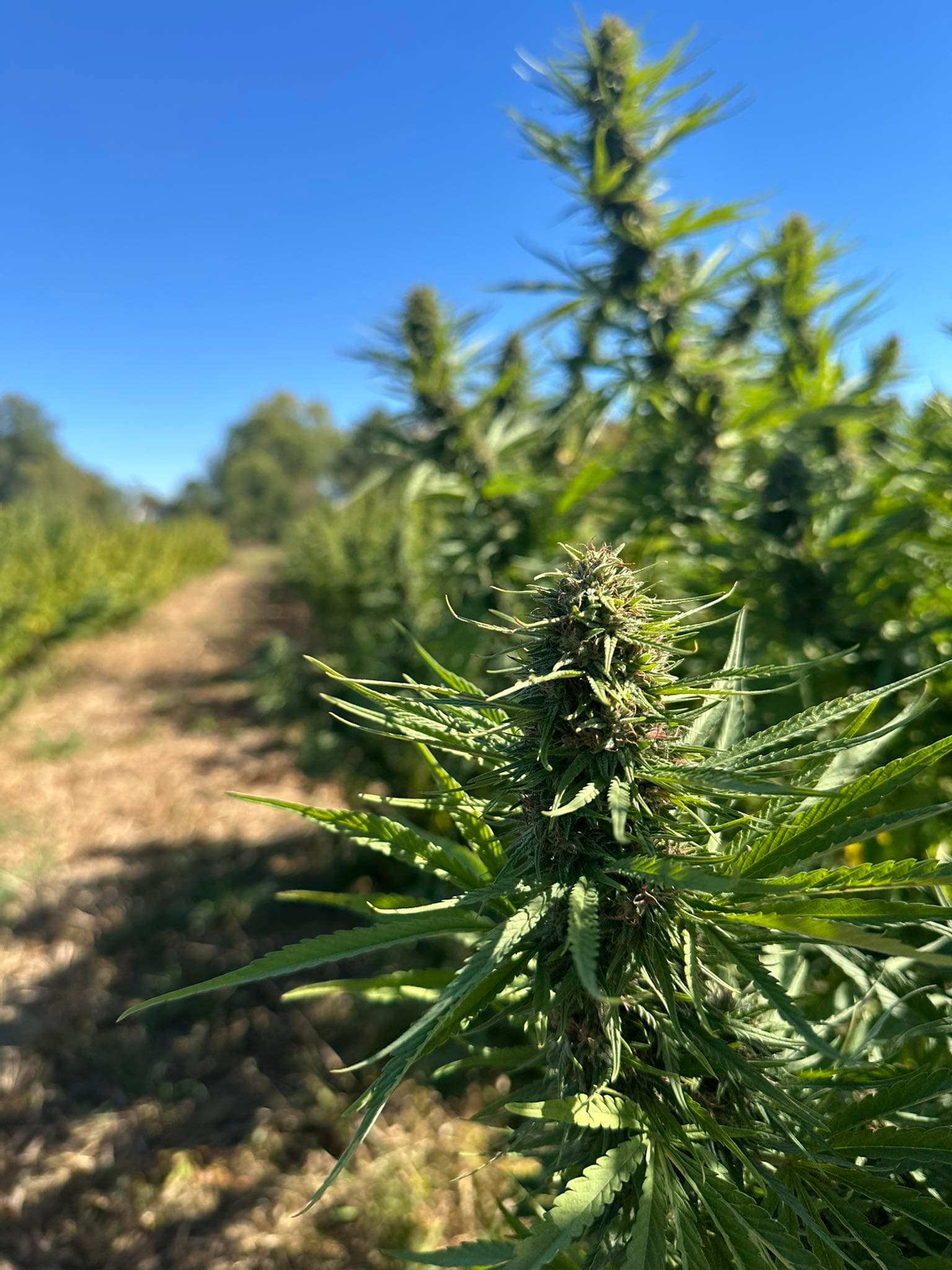
CBG vs CBD: What's the Difference?
CBG (cannabigerol) is the parent cannabinoid — the molecule the hemp plant synthesizes first. CBD (cannabidiol) is one of its derivatives. Both are non-psychoactive and federally legal, but they interact with different receptor systems and produce meaningfully different experiences. This guide breaks down exactly how they compare: the science, the effects, and which one fits your life.
Last updated: April 2026
The short answer
CBG is the precursor cannabinoid. Inside the hemp plant, cannabigerolic acid (CBGA) is synthesized first. As the plant matures, enzymes convert CBGA into CBDA (which becomes CBD), THCA (which becomes THC), and CBCA (which becomes CBC). By harvest time in a standard hemp cultivar, most of the CBG has already been converted — which is why CBD-dominant flower contains very little CBG, and why high-CBG flower requires either specialized genetics or precise harvest timing.
Both cannabinoids are non-psychoactive — neither will get you high. Both are federally legal under the 2018 Farm Bill when derived from hemp with less than 0.3% delta-9 THC. But their receptor profiles, reported effects, product ecosystems, and regulatory futures are distinct. Understanding those differences is what this page is for.
Side-by-side comparison
This table covers the eleven most important dimensions for consumers evaluating CBG and CBD. Every row reflects either published research, regulatory fact, or widely reported user experience (noted where applicable).
| Dimension | CBG (Cannabigerol) | CBD (Cannabidiol) |
|---|---|---|
| Psychoactive | No | No |
| Federal legal status | Legal (2018 Farm Bill) | Legal (2018 Farm Bill) |
| Biosynthetic origin | Parent cannabinoid (synthesized first) | Derivative (converted from CBGA) |
| Natural abundance in hemp | Rare (1-4% in standard cultivars) | Abundant (10-20%+ in CBD cultivars) |
| Primary receptor interactions | Alpha-2 adrenergic; weak partial agonist at CB1/CB2 | Negative allosteric modulator of CB1; 5-HT1A serotonin agonist |
| Reported primary effect | Calm focus, clarity, alert composure | Relaxation, tension relief, may promote sleep |
| Sedation tendency | Low — most users report no sedation | Moderate — higher doses can be sedating |
| Product availability | Primarily flower; isolate growing | Oils, capsules, topicals, gummies, flower, isolate |
| Typical flower price (3.5g) | $12-$30 (premium niche) | $8-$20 (commoditized market) |
| P.L. 119-37 compliance (Nov 2026) | Strong — naturally ultra-low total THC | At risk — many full-spectrum CBD products exceed the 0.4mg total THC cap |
| Available as smokable flower | Yes — primary format | Yes — one of many formats |
How they work: receptor mechanisms
The different effects of CBG and CBD trace directly to how each molecule interacts with receptor systems in the body. This section covers the pharmacology at a level useful for informed consumers — not a neuroscience textbook, but grounded in published research.
CBG's receptor profile
CBG interacts with alpha-2 adrenergic receptors, which play a role in regulating norepinephrine release, attention, and arousal. This interaction was documented by Cascio et al. (2010) in research on cannabigerol's pharmacological profile. It may explain why users consistently describe CBG as producing an alert, focused state rather than sedation.
CBG also acts as a weak partial agonist at both CB1 and CB2 receptors — the primary endocannabinoid receptors. Unlike THC, which is a strong CB1 agonist (producing intoxication), CBG's binding affinity at CB1 is too low to produce psychoactive effects. Its CB2 interaction may contribute to its anti-inflammatory properties observed in preclinical models.
Additional research has identified CBG's activity at TRPV1 and TRPV2 channels (vanilloid receptors involved in pain signaling) and as a PPAR-gamma agonist, a nuclear receptor involved in metabolic regulation and inflammation. These pathways are still being explored, but they expand the mechanistic picture beyond the endocannabinoid system alone.
CBD's receptor profile
CBD does not bind directly to CB1 or CB2 in the way THC does. Instead, it acts as a negative allosteric modulator of the CB1 receptor — meaning it changes the shape of the receptor in a way that reduces THC's ability to activate it. This is why CBD is sometimes described as "balancing" the effects of THC in full-spectrum products.
CBD also interacts with 5-HT1A serotonin receptors, which are involved in mood regulation, anxiety response, and nausea. This serotonergic activity is one of the most-studied aspects of CBD's pharmacology and is thought to underlie its anxiolytic (anxiety-reducing) reputation.
Like CBG, CBD also activates TRPV1 channels and interacts with the adenosine system, which regulates sleep-wake cycles. The adenosine mechanism may contribute to CBD's sedating quality at higher doses — a property that distinguishes it from CBG's more alert profile.
Note: The receptor interactions described above are based on published preclinical and pharmacological research. They are not medical claims, and human clinical outcomes may differ. Always consult a healthcare provider before using cannabinoid products.
Benefits at a glance
Both CBG and CBD have genuine utility. They are not competing — they serve different situations. Here is what each brings to the table based on user reports and available research.
CBG benefits
- Focus and clarity — the most consistently reported quality. Users describe a clear-headed calm that supports work, conversation, and creative tasks without mental fog.
- Calm without sedation — tension relief without the drowsiness that higher-dose CBD can produce. Suitable for any time of day.
- Ritual satisfaction — CBG's primary format is smokable flower. For people who value the act of smoking itself, it provides the full ritual: grind, pack, light, inhale, exhale. See 5 benefits of CBG flower.
- Ultra-low THC — high-CBG cultivars are naturally extremely low in total THC, keeping them well within both current federal limits and the upcoming P.L. 119-37 cap.
CBD benefits
- Relaxation and tension relief — CBD's interaction with 5-HT1A serotonin receptors gives it a distinct anxiolytic profile that many users find deeply relaxing.
- Sleep support — at higher doses, CBD's sedating quality can help users wind down in the evening. This is one area where CBD clearly outperforms CBG for most users.
- Broader product ecosystem — CBD is available as oils, tinctures, capsules, gummies, topicals, beverages, and flower. If you prefer non-smokable formats, CBD gives you far more options.
- Established research base — CBD has been studied more extensively than CBG, including the FDA-approved medication Epidiolex for certain seizure disorders. The evidence base for CBD is broader and deeper.
When to choose CBG
CBG flower is the right choice when your situation calls for clarity rather than sedation, and when the ritual of smoking is part of what you are looking for. Here are the specific use cases where CBG stands out.
- Tolerance breaks (T-breaks) — you are stepping away from THC but do not want to lose the smoking ritual or the subtle calm. CBG flower gives you both without resetting your timer. See CBG for tolerance breaks.
- Social smoking — you want to be in the circle, participate in the ritual, and not get high. CBG flower lets you roll up and join in without impairment.
- Daytime focus — you need something to take the edge off during work, creative sessions, or errands without any cognitive penalty. CBG's alpha-2 adrenergic receptor activity supports alert composure.
- Ritual seekers — you tried capsules, gummies, or tinctures and they felt like taking a vitamin. You want the physical, deliberate act of smoking — the grind, the roll, the five-minute pause. See how to smoke CBG flower.
- Flower-form preference — you specifically want smokable flower. CBG's primary format is flower. Our Stem Cell ($12-$55, 11-14% CBG) is built for daily use with clear focus. The White ($18-$80) is a premium evening option with deeper relaxation.
- Sober-curious consumers — you are exploring what it means to feel good without intoxication. CBG is non-psychoactive, non-addictive, and produces no impairment. See sober-curious alternatives.
When to choose CBD
CBD is the better choice when your priority is relaxation over alertness, when you prefer non-smokable formats, or when you want the reassurance of a deeper research base. Here are the situations where CBD wins.
- Sleep support — CBD's sedating quality at higher doses makes it a better evening wind-down option for users who struggle with sleep. CBG will not give you that same drowsy quality.
- Non-smokable formats — if smoking is not for you, CBD's product ecosystem is dramatically wider. Oils, capsules, topicals, gummies, and beverages are all readily available. CBG isolate and CBG oils exist but remain niche.
- Topical application — for localized muscle or joint support, CBD topicals are the established category. CBG topicals are emerging but not yet as widely available or studied.
- Evidence-first consumers — if you prefer to use products with a large clinical research base, CBD has the advantage. It is the most studied cannabinoid after THC, with Epidiolex serving as the first (and still only) FDA-approved CBD medication.
- Full-spectrum experience — many CBD products are formulated as full-spectrum, containing trace amounts of multiple cannabinoids (including small amounts of CBG and THC). If you want a broad cannabinoid profile in a single product, full-spectrum CBD is the established path.
Important regulatory note: under P.L. 119-37 (effective November 2026), many full-spectrum CBD products containing more than 0.4mg total THC per product will become non-compliant. If you currently use full-spectrum CBD, verify your product's total THC content before the law takes effect. CBG flower is unaffected by this change.
Can you use CBG and CBD together?
Yes — and there are good reasons to. CBG and CBD occur naturally together in full-spectrum hemp, and combining them intentionally is a practice gaining traction among experienced cannabinoid users.
The rationale traces to the entourage effect — the theory that cannabinoids, terpenes, and other hemp compounds work synergistically, producing effects greater than any single compound alone. While the entourage effect is still being researched, the basic observation that multi-cannabinoid formulations feel different from isolates is widely reported.
In practical terms, combining CBG and CBD flower means blending their respective profiles: CBG's clarity and focus balanced against CBD's deeper relaxation. Some users roll a blend of both into the same joint. Others smoke CBG during the day and CBD in the evening. There is no wrong approach — it depends on what you are optimizing for.
There are no known adverse interactions between CBG and CBD. Both are non-psychoactive and non-addictive. If you are new to cannabinoid blending, start with a small amount and observe how the combination feels before adjusting your ratio.
The 2026 regulatory picture
One of the most consequential differences between CBG and CBD going forward is regulatory. P.L. 119-37 takes effect in November 2026 and establishes a 0.4mg total THC cap per product. This is not a percentage limit — it is an absolute milligram threshold.
The impact on CBD: roughly 90% of current full-spectrum CBD products are estimated to exceed this cap. A standard CBD oil containing even trace amounts of THC in a 30mL bottle easily surpasses 0.4mg total. These products will need to be reformulated, reclassified, or pulled from shelves.
The impact on CBG: negligible. High-CBG flower cultivars produce naturally ultra-low total THC — well below the 0.4mg cap in any reasonable serving. CBG flower does not need to change to remain compliant. It is already there.
This does not make CBG inherently "better" than CBD — it means that if regulatory stability matters to you as a consumer, CBG flower occupies a structurally safer position heading into 2027 and beyond. For a deeper dive into the legal landscape, see our CBG legal guide.
Our CBG flower: Stem Cell and The White
Sober Sativas sources exclusively from Lifestyle Family Farms in Grass Lake, Michigan — a federally licensed hemp cultivator operating under Michigan's MDARD hemp program. Two strains are available, each serving a distinct purpose.
- Stem Cell ($12-$55) — 11-14% CBG. Designed for daily use. Clean, focused, no sedation. The all-day strain for work, errands, social time, or creative sessions. The name reflects CBG's role as the "stem cell" cannabinoid — the precursor from which others are born.
- The White ($18-$80) — premium CBG cultivar with a trichome-heavy, whitish-green appearance. Richer terpene profile. More suitable for evening use when you want deeper relaxation without psychoactive effects.
Every batch ships with a third-party Certificate of Analysis confirming CBG content, total THC levels, and the absence of pesticides, heavy metals, and microbials. No middlemen. No opaque supply chains. Farm to you. See our Compliance page for current COAs.
Frequently asked questions
Is CBG stronger than CBD?
They are not directly comparable by "strength" because they work through different receptors. CBG produces alert calm via alpha-2 adrenergic interaction; CBD produces deeper relaxation via 5-HT1A serotonin activity. Neither is psychoactive. The better question is which effect profile matches what you need.
Can I take CBG and CBD together?
Yes. They occur naturally together in full-spectrum hemp, and combining them intentionally is common. No known adverse interactions. Many users blend CBG and CBD flower or use them at different times of day. Read more about the entourage effect.
Why is CBG more expensive than CBD?
The hemp plant converts CBG into other cannabinoids as it matures. Producing high-CBG flower requires specialized genetics or precise early-harvest timing — both more resource-intensive than standard CBD hemp cultivation. The price gap is narrowing as CBG genetics improve.
Does CBG show up on a drug test?
Standard drug tests screen for THC metabolites, not CBG. However, any hemp flower may contain trace THC (up to 0.3% delta-9 under federal law). No hemp product can guarantee a negative drug test. If you are subject to testing, consult your employer before using any hemp product. See our CBG drug test guide.
Is CBG or CBD better for focus?
Users consistently describe CBG as the more focus-friendly cannabinoid. Research suggests its alpha-2 adrenergic receptor interaction (Cascio et al., 2010) supports attention and arousal regulation. CBD is more associated with relaxation. For daytime clarity, CBG is generally preferred. Individual experiences vary. Learn more about what CBG is.
Ready to try CBG flower?
Two strains. Farm-direct from Michigan. Third-party lab tested. Non-psychoactive. Federally legal. Ships to most U.S. states.